Bailey Bridge
ARTICLE · Miscellaneous · England · United Kingdom
Bailey Bridge
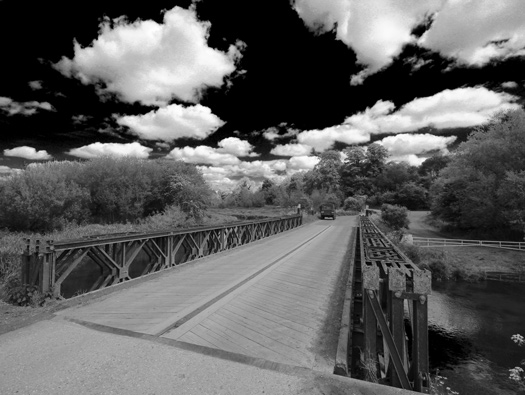
'B' Crossing on Salisbury Plain.
There are three crossings of the River Avon used by the army and all have Bailey bridges.
Sir Donald Coleman Bailey (born Sept. 15, 1901, Rotherham, Yorkshire, Eng.—died May 5, 1985, Bournemouth, Dorset) was a British engineer who invented the Bailey bridge, which was of great military value in World War II. After graduating from the University of Sheffield, Bailey worked for a time in railways, but then in 1929 he joined the staff of the Experimental Bridging Establishment of the Ministry of Supply. When World War II broke out, he had already developed an idea for a military bridge, and in late 1940, at a conference on the problem of providing temporary spans capable of taking heavy loading, his concept of a strong but relatively light steel truss that could be prefabricated in sections was at once approved. The characteristics of the Bailey bridge were standardization and simplicity of panels, readiness of assembly in the field, capacity for additional strengthening by doubling or tripling the truss girders, and adaptability to long spans with the aid of pontoons. A Bailey pontoon bridge over the Maas River in the Netherlands spanned 4,000 feet (1,200 m). Bailey was knighted in 1946. (Britannica)
30 May 2014
Bailey Bridge
Bailey Bridge
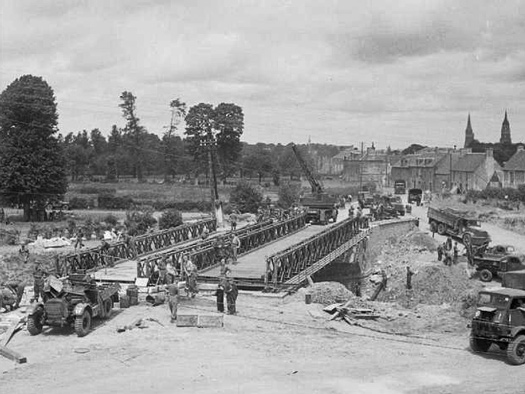
4 July 1944.
Bailey Bridge
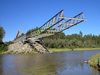
Saint-Loup-Hors, near Bayeux today.