RFC/RAF Upavon, Wiltshire or 'Siberia'
RFC · Wiltshire · England · United Kingdom

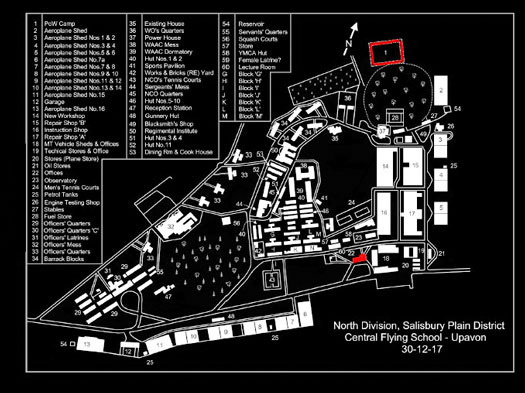
RFC Upavon 30-12-1917.
Red building - HQ.
Red square - the Prisoner of War camp.
Plan 1917
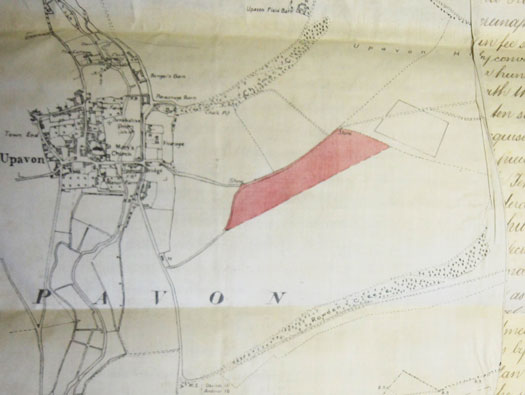
The Beginnings of British Military Aviation – Upavon, 1912
1910, to me, marked the beginning of British military aviation. The Government, the Army and the Navy had all decided that aircraft were something they needed, and gradually money was made available to develop this new military capability.
The next stage, on 28th February 1911, was an Army Order which brought into being the Air Battalion of the Royal Engineers on the 1st of April of that year. This consisted of an HQ at South Farnborough, No.1 (Airship) Company also at Farnborough, No.2 (Aeroplane) Company at Lark Hill on Salisbury Plain.*
*CFS Birthplace of Air Power.
To fly for the military, however, you first had to obtain your own flying certificate. This meant learning to fly at a civilian flying school. There were several by this time, including Hendon, Leysdown, Brooklands, Lark Hill, etc.
You had to pay the £75 required for your flying training and certificate before applying to join the military flying service, either the Army's Royal Flying Corps (RFC) or the Navy's Royal Naval Air Service (RNAS), when you were re inburst your £75.
By 1912, the military had decided that it needed its own flying school for Pilots who already held their flying certificates and would be accepted and then taught to fly in the Military Way.
For the Army, this meant learning to fly ahead of the troops, searching for the enemy (reconnaissance) and working with the artillery. The Navy had rather different requirements, concentrating on reconnaissance and, increasingly, anti-submarine duties.
Choosing the site at Upavon
A site was eventually found a few miles north of Lark Hill*, on the high ground above Upavon on Salisbury Plain.
* Lark Hill later became known as Larkhill, around 1916. It was also associated with Durrington Camp.
There were several reasons for choosing this location. One of the most important was its isolation. In those early days of aviation, whenever the public saw aircraft flying, people would flock to watch. Newspaper reporters were not far behind, often hoping to get a story, particularly if there had been a crash.
The military wanted somewhere away from the crowds and newspaper attention, where flying could take place without unnecessary interference. Upavon was ideal. It was several miles from a railway station and a mile or two from the nearest village. It was also on high, open ground, sloping away to the west with plenty of room for flying.
The land was acquired from local landowners, and planning and building work began in 1912. The first buildings were temporary, and construction continued over the following years. Many of the more substantial buildings appeared from 1913 onwards.
The flying field was laid out on the chalk downs. The ground offered good drainage, was relatively level and, importantly, had no trees to obstruct flying.
The London Road gave good access.
Alongside the road, a number of buildings were erected. In those days, aircraft hangars were commonly referred to as sheds, and these were arranged in rows, with another group set out at right angles across the northern side of the site.
The establishment needed much more than just a flying field and somewhere to keep the aircraft. It had to be a complete military training station.
Buildings and facilities included:
Headquarters and administration offices.
Classrooms for ground instruction.
Barracks for the men.
An Institute for recreation and general facilities.
A Sergeants' Mess.
An Officers' Mess.
Accommodation for officers.
Aircraft erection, repair and maintenance sheds.
Workshops and training facilities.
A water supply and power station.
A Prisoner of War camp, which I will come back to later when we look at the POWs.
It was quite an undertaking, effectively creating a small military community on the open Wiltshire downs
Swindon Library
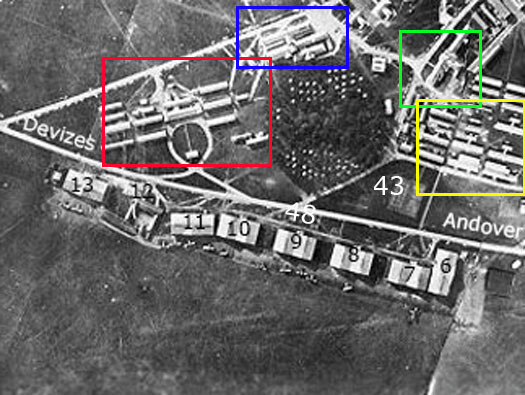
Red - Officers Quarters.
Blue - Officers Mess.
Green - Sergeants Mess.
Yellow - Lecture rooms.
6to13 - Aeroplane Sheds.
43 - NCO's Tennis Courts.
48 - Gunnery Hut.
Air 1917
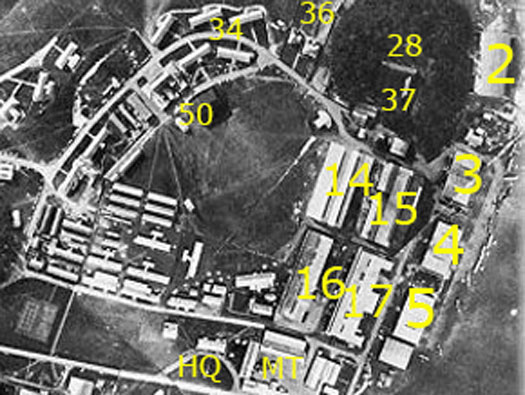
2to5 - Aeroplane Sheds.
14 - Workshops.
15 - Repair Shop 'B'.
16 - Instruction Shop.
28 - Fuel Store (coal).
34 - Barrack Blocks.
36 - WO's Quarters (Married Quarters).
37 - Power House.
50 - Regimental Institute.
Air 1917
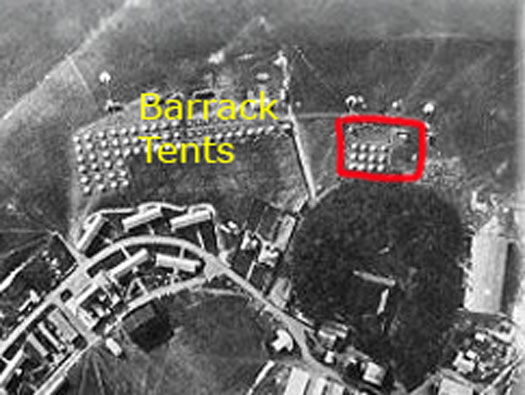
By 1917 there was not enough accommodation, extra Bell tents were used.
Red square - POW camp.
Why a Prisoners of War camp.
1907 Hague Convention.
Labour Regulations: Captors may utilize the labour of able-bodied non-officers based on their rank and aptitude, provided the work is not excessive and has no connection with war operations (such as manufacturing or transporting arms).
Although rules are rules, both sides flouted them. The British used German POW's to help erect nearly all of their TDS (Training Depot Stations) from 1917 on. So having POW's close at hand, you had a good workforce, ready and able to work.
Air 1917
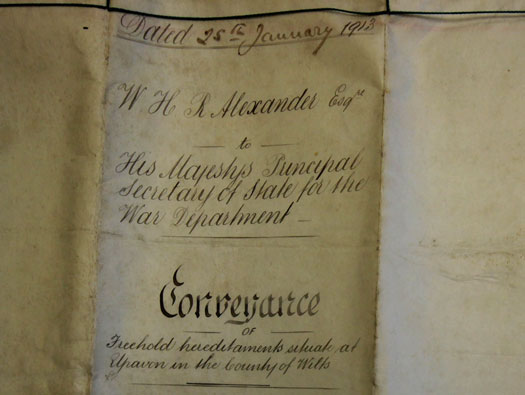
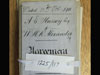
The Agreement between WHR Alexander Esq. to His Majesty's Principal Secretary of State for the War Department. 25 January 1913.
WHC Chipp. 1225/117
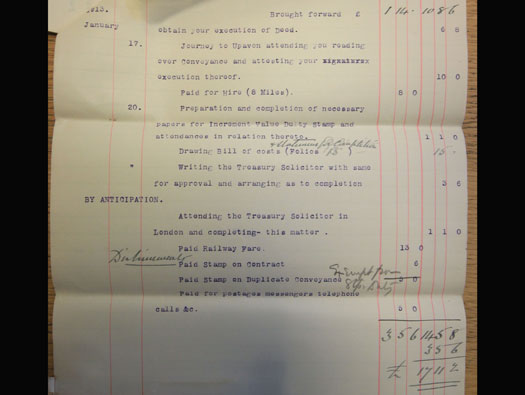
Now we come to the cost, not the cost of the land to the tax payer, but WHR Alexander Esq.'s solicitors costs. This is what makes history interesting, the small details.
The COST to WHR Alexander, £17 pounds, 11s Shillings and 2d pence.
£17-11-2d.
No decimals 240d to the pound. 20 shillings to the pound.
I am old enough to remember pre decimal currency and we had to work out and take money and then give change. How I managed I do not know. I do remember getting a very nice Casio calculator when Decimal came it. What a great relief.
The other interesting item is, the solicitor charged 1s per mile.
WHC Chipp. 1225/117
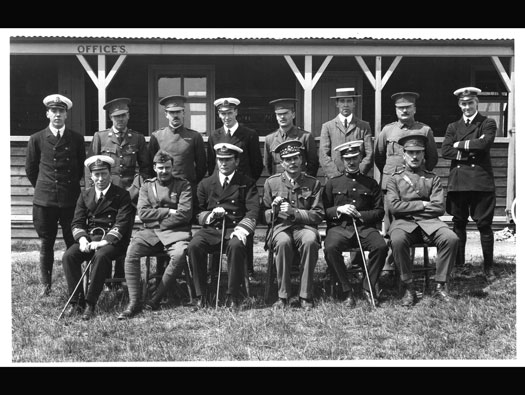
Central Flying School staff in January 1913.
2/Lt R. Abercromby, Lt. A. Allen
Lt. E.V. Anderson, Lt. P. Atkinson
Capt. J.H. Beke, Lt. R. Cholmondeley
Lt-Col. H.R. Cook, Capt. R.H. Corner
Lt. I.T. Courtney, Capt. J.D.B. Fulton
Maj. E.L. Gerrard, Maj. J.F.A Higgins D.S.O.
2/Lt T.O.B. Hubbard, Lt. Qmr F. Kirby VC
Asst Pmr J.H. Liddesdale R.N., Lt-Cdr A.M. Longmore
Lt. R.B. Martyn, Lt. J.W. Pepper
Eng. Lt. C.J. Randall R.N., Capt. C.E. Risk
Lt. D. Shephard R.N., 2/Lt R.R. Smith-Barry
Lt. G.B. Stopford, Maj. H.M. Trenchard DSO
Lt. F. F. Waldron, Lt. G. Wilman-Lushington
Lt. S. Winfield-Smith, 2/Lt D. Young.
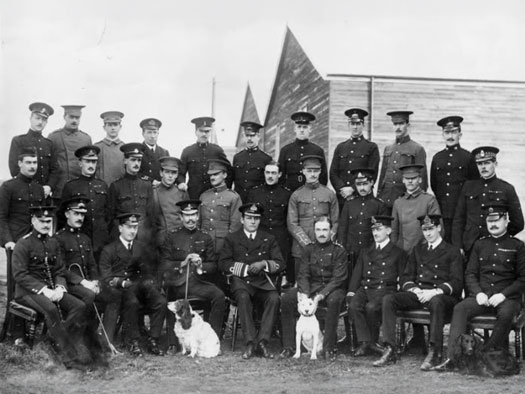
August 16 1913. The Central Flying School.
The following officers qualified at the Central Flying School, Upavon, on August 1913 :-
Capt. W. Picton-Warlow and Lieut. G.E. Todd, Welsh Regt.; Lieuts. U.J.D. Bourke, Oxfordshire and Buckinghamshire L.I.; M.W. Noel, Liverpool Regt.; Sec.Lieuts. R.M.Vaughan, Royal Inniskilling Fusiliers; A. Shekleton, Royal Munster Fusiliers; W.C.K. Birch, Yorkshire Regt.; and G.F. Pretyman, Somerset L.I.
Also members of the permanent staff and their dogs.
The wooden huts were the temporary hutting placed here first.
Off. photo
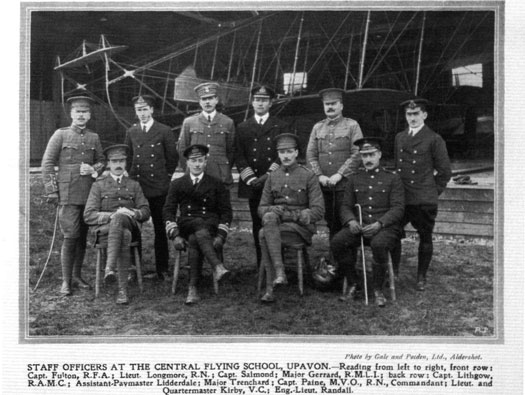
The Farman in the background used as one of the training aircraft.
The schools original staff was as sparse as its facilities. Only twelve
officers were employed at the school when the first course began in August 1912.
These included the secretary, the theory and construction instructor, the meteorology
instructor, the engine instructor, five flying instructors, the medical officer, the quartermaster, and the commandant, Godfrey Paine, a naval officer who himself did
not know how to fly. He had been hand-picked by First Lord of the Admiralty Sir
Winston Churchill, who informed Paine that he was going to be heading the school
by telling him that he "had better learn to fly". Despite his inability to pilot an
aircraft, Paine was actually a logical choice to head the CFS; he was familiar with
the particulars of military aviation, and was the former commandant of the Naval
Flying School at Eastchurch. Joining the twelve officers were fifty-four enlisted
men and non-commissioned officers, mostly warrant and petty officers (technicalinstructors), and twenty civilians (labourers and mechanics).
Similarly, the schools complement of airplanes was small and anything but
state-of-the-art. The British aviation industry was not in apposition to provide aircraft for the school in 1912. As a result, the CFS used eight French Henri and Maurice Farman aircraft equipped with Gnome and Renault engines. This deficit would be remedied after the first CFS course. By the beginning of the second course British aircraft were beginning to trickle into the school. Even so, the new British airframes were built around the French Renault or Gnome engines.
The first course of instruction at the Central Flying School began on August 17, 1912. In contrast to the difficulties involved in establishing the school, it was no problem at all finding men to fill the cockpits of the CFSs training aircraft. A list of the pupils of the first training course at the CFS reads like a who's who of future RFC and RAF leaders in both world wars: Hugh Trenchard, who became leader of the RFC in the field during the First World War; J. M. Salmond, who later became chief of the air staff and a knight; and Robert Smith-Barry, the man who revolutionized British pilot training later in the war (and who will later appear as a central figure in this thesis). With these three were eleven other would-be pilots from the army (who formed the majority), navy, and civilian life. These men were housed off-site in local inns, as their barracks and mess halls were not yet completed. Nevertheless, they did not seem to mind their accommodations; their memoirs contain numerous references to enjoying life in the local pubs and taverns when they were not in the classroom, workshop, or the air.
(Earning Their Wings: British Pilot Training, 1912-1918)
Officers of the CFS.
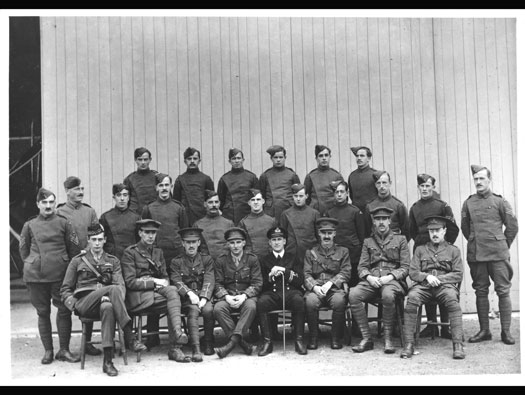
This is a slightly later photo after the men have been issued with their new RFC Model 1912 Maternity Jacket. The Officers are wearing their regimental and Naval uniforms.
Only two of the Officers have wings up, so they would have been the flying instructors.
NP
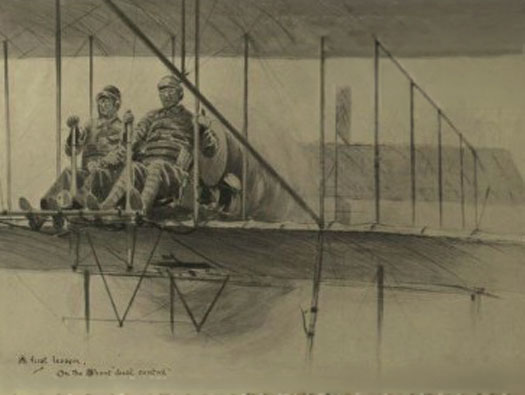
'A' and 'B' flights began with the most elementary training and spent considerably more time learning the nuances of flying basic aerial manoeuvres, internal-combustion engine and airframe work and so on.
'C' and 'D' flights typically skipped the basic flight instruction and quickly moved to more advanced manoeuvres in the aircraft, practical instruction on its construction and components, and wartime applications of the aircraft in war (at this time, artillery direction and reconnaissance).
(Earning Their Wings: British Pilot Training, 1912-191
Illustrated London News. April 1913
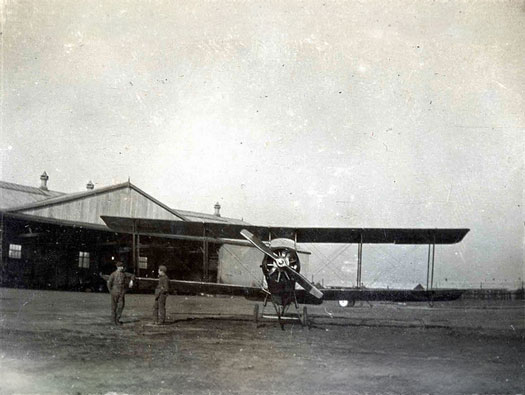
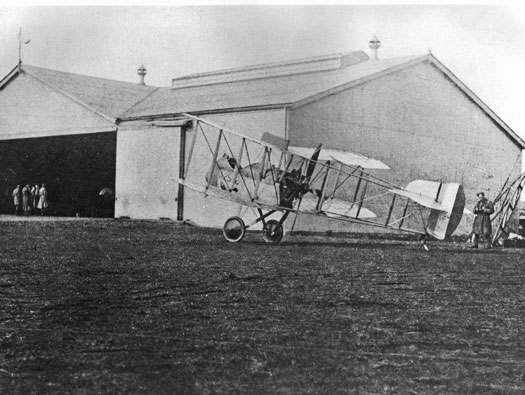
A Avro 500 outside a 1913 side opening shed.
IWM CFS Album
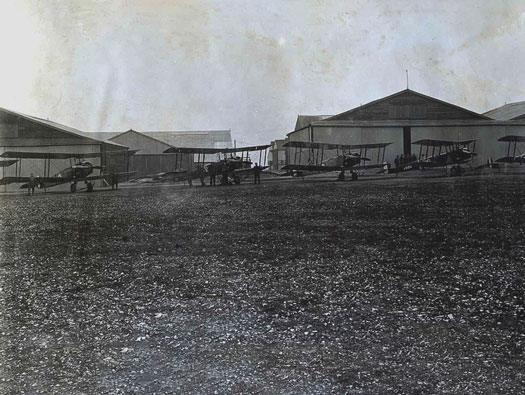
I cannot see exact where this photos was taken, there are five Avro 500's on the tarmac.
The Tarmac - the aircraft parking area outside the hangars.
IWM CFS Album
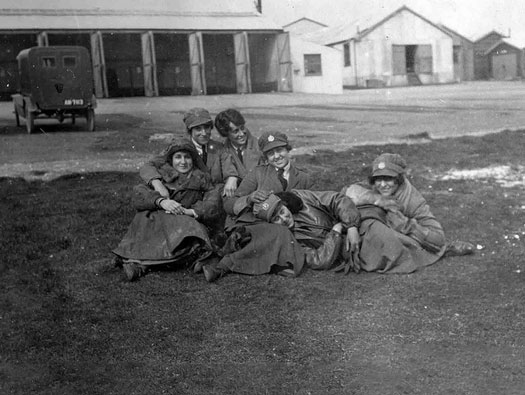
Girls of the Motor Transport (MT) outside the MT yard at Upavon.
Behind to the right is:
19 - Technical Stores and Office.
IWM CFS Album
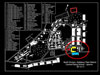
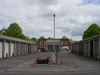
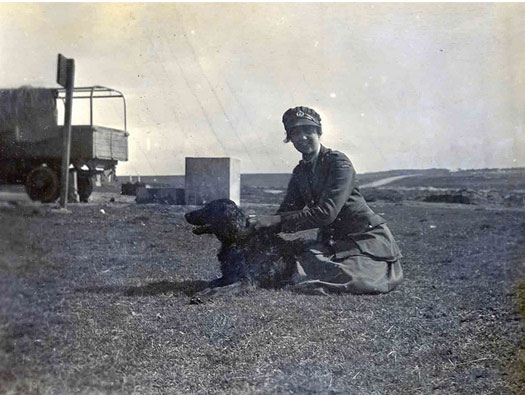
Lady of the MT sitting by the vehicle wash down. The road is heading off for Andover.
Women's Army Auxiliary Corps. (WAAC).
IWM CFS Album
NP
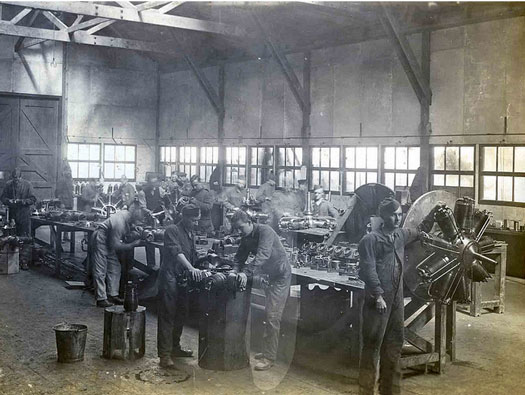
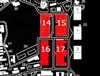
14 - New Workshop.
15 - Repair Shop 'B'.
16 - Instruction Shop.
17 - Repair shop 'A'.
CFS 1913
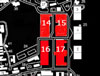
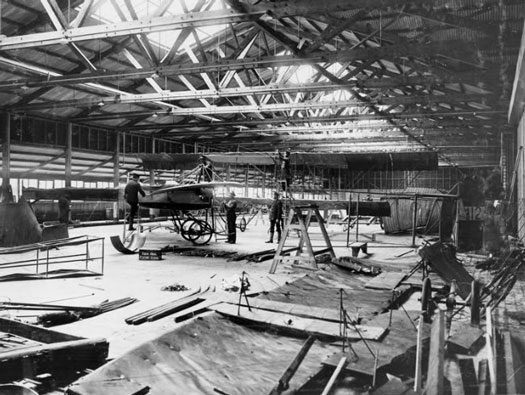
14 - New Workshop.
15 - Repair Shop 'B'.
16 - Instruction Shop.
17 - Repair shop 'A'.
CFS 1913